





Facility Planning & Operations: Gymnasiums
|
On Your Marks The art of lining fields, rinks, tracks and courts requires the proper materials and some knowledge of science.
By
Paul Steinbach
Most dedicated groundskeepers, facilities operators and independent contractors strive to elevate athletic surface preparation to an art form. In fact, some of them may even call themselves artists—and rightfully so. Few things add more visual appeal to a sporting event than the vibrantly marked surface on which it is played. But whether the canvas is acres of turf, a vast span of ice, miles of track or an entire field-house floor of hardwood, these artists need more than just any old paint on their pallet. In selecting marking materials for best results on virtually any given sports surface, artistic flair will fade over time unless a little knowledge of science is added to the mix.
Athletic Fields Water-based paints are the preferred choice, since they adhere to grass without impeding photosynthesis and the elongation of the grass blade. Chalk, typically limestone or marble, is less friendly to turf because it builds up over time and slows down water movement to a grass plant’s root structure. Chalk should only be used on the skinned infield surfaces of baseball or softball diamonds, and even then it should be applied lightly and dragged into the base infield material after games or removed with a shovel. Chalk can be avoided altogether by spray-painting baselines and batter’s boxes. For paint to adhere cleanly to dirt or clay, the ground must first be wetted down. When it comes to turf paints, there are two ingredients to which groundskeepers should pay particular attention: titanium oxide (pigment) and calcium carbonate (filler). The higher the concentration of titanium oxide (TiO2), the brighter the paint will appear on turf. Generally, a halfpound of titanium oxide in a gallon of white line paint will produce a visible line if mixed one part paint to one part water. A full pound of titanium oxide per gallon will give the user a brighter line at 1-to-1 or allow the user to cut the mixture with up to three parts water. Other turf paints now available contain nearly four pounds of titanium oxide per gallon, allowing for a range of mixture ratios up to 9-to-1, depending on the brightness desired. Paints containing low amounts of titanium oxide typically contain higher concentrations of calcium carbonate (CaCO2). Used in paint as filler, calcium carbonate is also an ingredient used in mixing certain types of cement and can be used to chalk baseball and softball infields. However, its presence in high concentrations in turf paint can damage grass. If applied often enough to the same area, calcium carbonate will eventually migrate several inches into the soil and harden, choking off grass plants at their roots. Likewise, calcium carbonate in a bucket of mixed paint will settle and harden overnight, rendering unused paint mixed for one day’s work useless for the following day. Grounds maintenance personnel should be particularly careful in their use of color paints. Because pigments used in color paints are more transparent (and expensive) than those in white paint, it’s not uncommon to find high concentrations of calcium carbonate in color paints. This transparency also means that color paints cannot be diluted with water beyond a 1-to-1 ratio, and several applications may be necessary to sufficiently brighten the appearance of the paint on grass. This will lead to calcium carbonate buildup, which can make the playing surface (particularly a football field’s end zones) abrasive—or worse, kill the turf. Materials added to a paint supply after purchase can also cause harm to grass plants. To save time and money, some groundskeepers may attempt to stunt the growth of the grass being marked by blending turf-growth regulators or nonselect herbicides into the paint. The goal is to keep the line intact longer between applications by keeping the marked grass at a lower height than the rest of the field, thus lessening the likelihood that paint on the grass blade will be mowed off. Turf-growth regulators can be successful in achieving this desired result, but non-select herbicides will only kill quality turf and create a weed bed wherever the field’s lines are located. To make the green grass of an athletic field greener, both paints and dyes can be used without risk of harming the grass plants. Artificial greening alternatives are typically employed on a perevent basis, since paint applied to healthy grass blades will eventually be mowed off, and dies dissipate through sun bleaching, irrigation and rain. Of course, some of the greenest fields aren’t grass at all, and synthetic playing surfaces require their own marking considerations. Synthetic turf fibers (typically made of nylon, polyester or polypropylene) are slicker than grass blades, and even quality water-based paints will adhere to them for only so long. For that reason, synthetic turf may require marking maintenance two or three times during a normal football season. More durable polyurethanebased paints provide best results on synthetic turf. On synthetic surfaces that host teams with different field-marking requirements, the paint formulation can be tweaked to facilitate quick changeovers. For example, a college game played on Saturday will require a different hash-mark configuration (and perhaps different end-zone graphics) than a professional game played the next day. The paint used to mark the college field should contain a decreased amount of acrylic, the ingredient that makes paint stick to the playing surface. This altered formulation will endure the rigors of a game, but allow for easy removal with a power washer, leaving the more-permanent professional markings intact for Sunday’s contest. Some venues with synthetic surfaces are forgoing paints entirely in favor of lines and hash marks that are white synthetic- turf inlays. Logos can be inlaid using precision-cut color turf. This option creates unparalleled contrast between colors on the playing field but also adds many more seams to the surface. With increased numbers of seams come increased risk of the turf pulling up and creating hazards for players. Careful installation of each line, hash mark and logo is critical.
Ice Sheets Once the paint has dried, thoroughly wash it off with a hose to reduce the paint’s sheen and remove any impurities that may have accumulated on the slab’s surface. While the above method can be used to create the ice sheet’s white background — as well as the lines, circles, dots, and team and sponsor logos common to hockey rinks—alternative marking methods can be employed throughout the ice-making process. In the past, a common practice was to mix lime with the water being applied to a rink when the ice was at a quarter-inch thickness. Some facility operators still use lime, though the amount needed to sufficiently whiten an 85-by-200-foot rink is more than the Environmental Protection Agency allows for that amount of square footage. For this reason, some rinks have switched from lime to calcium carbonate as an ice whitener, but it too has drawbacks. Calcium carbonate can coat drainpipes and pump housings with a cement-like residue over time. For the modern ice rink, it is recommended that operators consult manufacturers of paints specifically formulated for application on ice. Newer ice paints are designed to create a stark white surface. They are easy to apply, easy to remove and easy on the environment. Even so, the latest whitening materials should not be applied using a facility’s ice resurfacer, since paints can create damaging buildup within the machine’s water tanks. As an alternative to liquid mixes, paper can be used to give ice a bright white appearance. Pulled from rolls several feet wide, this tissue-like material is applied with a mist of water to provide full, overlapping coverage of the rink. Though especially effective for outdoor rinks subject to temperature fluctuation (ice paint may migrate when heated, creating a mottled surface), paper has drawbacks of its own. If not applied properly, it may trap air pockets in the ice that give a cloudy appearance to the surface and inhibit heat transfer. And removing an ice sheet containing paper can be messy, particularly on sandbased rinks. Once an additional eighth-inch to a quarter-inch of ice has been built on top of the white layer, the marking of lines and circles can take place. Again, paper and paint are the preferred methods. Paper is the quicker (a two-hour job for two skilled individuals) and less-expensive option. Depending on how the paint is applied, painting a rink may take three individuals up to six hours. When choosing the best paint for a clean line, consult several ice paint manufacturers. Experimentation with tempera and watercolors may work in the short term, but their markings will lose definition over time. Latex paints contain salts and solvents that will ruin ice and make repair nearly impossible, short of chipping out the entire area of contact. Perforated plastic is also available for marking lines, but may bring the same negative qualities to ice as petroleumbased paints. Plastics are nonabsorbent and water-resistant, nonporous and somewhat insulating. Ice may treat plastic as an extreme impurity and force it to the surface over time. In addition, the skating surface will only exhibit the tensile strength of the ice above a plastic line, making ice containing poorly installed plastic lines susceptible to hazardous cracks. Cloth can also be used to mark ice. It is more expensive but easier to install than paper, since it can be pulled off ice without tearing in the event of an installation error. For tasks such as coloring the goal creases light blue, a facilities operator may choose to purchase the proper square footage of lightweight cloth from a local fabric store and set it in the rink with satisfactory results. Lettering and logos can also be applied, typically with paint or paper. These graphics are often laid closer to the surface in case their removal is necessary — the theory being that sponsors may come and go, but the rules of the game never change.
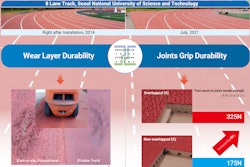
Tracks Facilities with asphalt tracks have been known to use oil-based traffic paints to mark lanes, but this can prove to be a mistake in the long run. If a new surface coating is ever to be added to the asphalt track, the oil-based markings must be completely stripped down to allow for an adequate bond. The same goes for seal coats on asphalt painted with oil-based materials. Cinder tracks are typically marked with lime, which can be colored to accommodate the different markings on a track surface.
Hardwood Floors Some disagreement exists in the flooring industry over what marking materials work best and what causes incompatibility. Some claim that chemical pigment additives required to create customized colors (school colors, for example) can alter a paint’s chemistry significantly enough to inhibit a bond between the paint and chosen finish. Conversely, one contractor says he can send a client to the hardware store for paint of any color, as long as it’s a water-based latex, and there will be no problem getting it to bond with an oilmodified polyurethane finish, which this contractor prefers over waterbased finishes. Other roadblocks to bonding may include applying game lines too thickly and in less-than-ideal drying conditions (high humidity), not allowing game lines to properly dry and cure, or failure to adequately abrade dried game lines prior to the application of finish. Tape represents another, often temporary, alternative to marking hardwood floors. However, tape can leave adhesive residue on surface finish or create a bond with the surface finish that’s stronger than the paint/finish bond beneath the surface. When removed, tape may pull finish off paint and, in fact, can be used as a means to test bonding between line paint and finish. Whenever using tape to mark floors temporarily, select an easy-release taping product specifically designed to be applied and removed.
Tennis Courts In addition to aggregate, hard-court paints contain other ingredients not necessarily found in other sports surface coatings. Surfactants aid in the smooth application of the coatings, then eventually wash out of the surface. (Newly applied tennis coatings that bubble in a rainfall are releasing surfactants.) Antibacterial agents are also added to tennis coating formulations to keep the paint from spoiling in the event that bacteria contaminate an open container of paint before it is resealed. Because hard courts are textured, lining them requires an extra step and additional materials. Masking tape will not adhere evenly to a rough surface coating, causing line paint to bleed underneath the tape in areas lacking adhesion between tape and court. When the tape is removed, the line will exhibit a serrated edge. To produce sharp lines, a clear latex sealer is applied over the masking tape, filling in the voids. Two coats of textured line paint can then be applied without fear of migration. Groundskeepers, facilities operators and independent contractors who exhibit creative flair can turn the mundane markings of an athletic surface into a masterpiece of well-defined lines and logos. But whether their work will stand the test of time may be determined early in the creative process through the selection of marking materials, which must endure not only the critiques of coaches, players and fans alike, but natural forces and chemical reactions, too. Truly successful professionals have not only elevated surface preparation to an art form, they’ve got it down to a science.
|
Featured Vendor
|


See project slideshow